
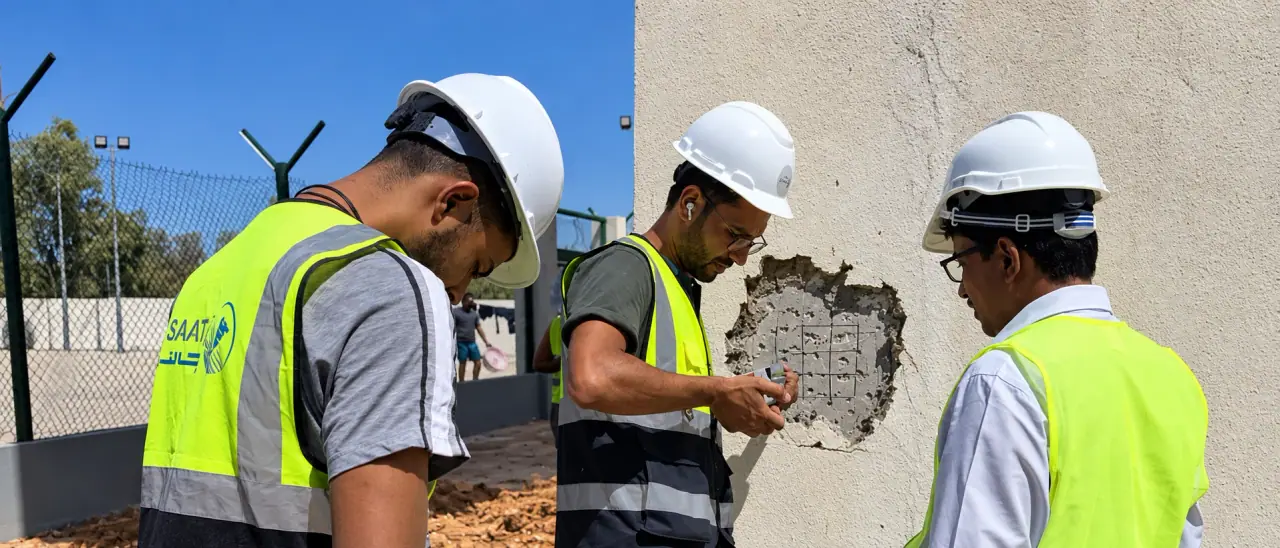
Buildings are affected by age, moisture, salts and the way they are used. A structural evaluation establishes the actual condition of the concrete members, so that decisions on maintenance, repair, strengthening or adding floors rest on facts.
Signs that call for an evaluation
- Cracks in columns, beams or slabs.
- Spalling of the concrete cover or rust stains.
- Visible sagging of slabs or unusual vibration.
- Persistent water leaks, especially in basements and wet areas.
- Plans to add floors or change the use of the building.
- A fire, or settlement of the foundations.
Non-destructive tests
- Schmidt hammer: measures the surface hardness of concrete and gives a quick indication of its strength, ideally correlated with core results.
- Ultrasonic pulse velocity: reveals internal voids and cracks and assesses how uniform the concrete is.
- Rebar detectors: locate the bars and measure the concrete cover.
Tests that need samples
- Cores: cut from the member and crushed in the laboratory to find the actual concrete strength.
- Carbonation test: measures the carbonation depth, beyond which reinforcement loses its protection against rust.
- Reinforcement corrosion testing to assess how far rusting has spread.
Slab load testing
Part of the slab is loaded with calculated loads, and the deflection is measured during loading and after the load is removed, to confirm the slab can carry the required loads.
The results are brought together in a report that describes the condition of each member and recommends the right action: maintenance, repair or strengthening.